 Ds Times
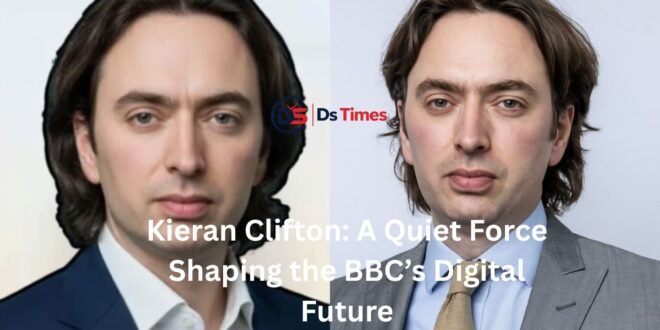
There’s a certain type of media executive who thrives on attention. Big quotes, big promises, big presence. Then there’s the other kind. The ones who quietly steer massive organizations through complicated change without constantly stepping into the spotlight.
Kieran Clifton fits firmly into that second category.
If you’ve ever used BBC iPlayer, browsed BBC Sounds, or noticed how the BBC seems to keep up with the streaming age better than many legacy broadcasters, you’ve already felt the impact of his work. You just might not have realized who was behind it.
Let’s talk about why that matters.
The Man Behind the Screens You Already Use
Kieran Clifton isn’t a celebrity executive. He’s not trying to be. But his role at the BBC places him right at the center of one of the toughest challenges in modern media: how do you take a nearly 100-year-old institution and make it feel relevant in a world of Netflix, YouTube, and TikTok?
That’s not a small problem.
Think about your own habits for a second. Maybe you sit down to watch something and instinctively open a streaming app. Maybe you expect content to be available instantly, on demand, and tailored to your taste. That expectation didn’t exist in the same way 15 or 20 years ago.
Clifton’s work lives in that gap between old expectations and new ones.
From Policy to Product
Before stepping into senior roles at the BBC, Clifton had a background that mixed policy, regulation, and strategy. That might sound dry on paper, but it’s actually the kind of experience that becomes incredibly useful when you’re dealing with public service broadcasting.
Because here’s the thing. The BBC isn’t just another media company chasing profits. It has obligations. Cultural ones. Political ones. Public trust is part of its currency.
So when someone like Clifton helps shape digital strategy, it’s not just about “what gets clicks.” It’s also about what serves the audience in a broader sense.
Imagine you’re deciding what shows to push on a homepage. A purely commercial platform might prioritize whatever keeps users watching the longest. The BBC has to think differently. It has to balance popularity with diversity, education, and representation.
That’s where his background comes into play.
The Shift to Digital Isn’t Optional
Let’s be honest. Traditional TV isn’t what it used to be.
People still watch it, sure. But the dominance is gone. Streaming has changed the rhythm of how content is consumed. Younger audiences especially don’t think in terms of schedules. They think in terms of availability.
Clifton has been deeply involved in pushing the BBC further into that digital-first mindset.
You can see it in products like BBC iPlayer, which has evolved from a simple catch-up service into something much closer to a full streaming platform. Or BBC Sounds, which tries to rethink radio and audio for a podcast-driven world.
None of that happens by accident.
It takes someone willing to challenge legacy systems. Someone who can sit in a meeting and say, “This worked for decades, but it won’t work going forward.” That’s not always a comfortable conversation, especially in an institution with as much history as the BBC.
Balancing Innovation with Identity
Here’s where things get tricky.
If the BBC moves too slowly, it risks becoming irrelevant. If it moves too fast, it risks losing what makes it unique.
Clifton’s role often sits right in that tension.
Take something simple like personalization. Most modern platforms rely heavily on algorithms to recommend content. It’s efficient. It keeps people engaged. But it can also create echo chambers.
Now imagine applying that to a public broadcaster. Do you only show people what they already like? Or do you gently push them toward new perspectives?
That’s not just a technical question. It’s a philosophical one.
And it’s the kind of decision that defines whether the BBC remains a public service or drifts toward becoming just another streaming service.
A Different Kind of Leadership Style
You won’t find endless headlines about Clifton making bold, flashy statements. His influence shows up in quieter ways.
People who’ve worked in large organizations know this type well. The leader who asks precise questions. The one who focuses on systems instead of soundbites. The one who cares more about whether something works than whether it looks impressive in a press release.
It’s not glamorous. But it’s effective.
Think about a project that actually improved your daily routine. Maybe an app update that made something easier. You didn’t celebrate it. You just kept using it. That’s often the kind of impact Clifton’s work has.
The Challenge of Public Expectations
Working at the BBC means working under constant scrutiny.
Everyone has an opinion about it. Some think it’s too traditional. Others think it’s trying too hard to modernize. Some want more entertainment. Others want more serious content.
Clifton’s role involves navigating all of that while still pushing forward.
It’s a bit like trying to redesign a city while people are still living in it. You can’t just shut everything down and start fresh. You have to build, test, adjust, and roll things out gradually.
And every change gets noticed.
Technology Isn’t the Whole Story
It’s easy to assume that digital transformation is mostly about tech. New platforms, better apps, smarter algorithms.
But Clifton’s work highlights something people often overlook: culture matters just as much.
You can build the best system in the world, but if the organization behind it isn’t ready to use it properly, it won’t succeed.
That means shifting how teams think. Encouraging experimentation. Accepting that not every idea will work.
Imagine a producer who’s spent decades working in traditional TV suddenly being asked to think about user data, streaming behavior, and digital engagement. That’s a big shift.
Helping people make that transition is part of the job.
Why His Work Matters More Than It Seems
At first glance, someone like Kieran Clifton might not seem especially relevant to the average viewer. He’s not on screen. He’s not creating shows.
But his decisions shape the environment where all that content lives.
If the platform is clunky, people won’t use it. If discovery is poor, great shows get lost. If the digital experience feels outdated, audiences drift away.
You’ve probably experienced this yourself. You open an app, can’t find what you want in a few seconds, and close it. That’s it. You’re gone.
Clifton’s work is about preventing that moment.
The Broader Media Landscape
The BBC doesn’t operate in isolation. It’s competing, directly or indirectly, with global giants like Netflix and YouTube.
That changes everything.
Those platforms have enormous budgets, global reach, and different rules. They can take risks the BBC can’t. They can move faster in some ways.
So the question becomes: how does the BBC stay relevant without trying to copy them?
Clifton’s approach seems to lean toward adaptation rather than imitation. Use modern tools. Embrace digital habits. But keep the core mission intact.
It’s not about becoming Netflix. It’s about being a BBC that works in a Netflix world.
Small Changes, Big Impact
Not every improvement is dramatic.
Sometimes it’s about making search faster. Sometimes it’s about improving subtitles or accessibility. Sometimes it’s about how content is categorized so people can actually find it.
These are small details. But they add up.
Think about the last time you used a service that just felt easy. You didn’t notice why. It just worked. That’s often the result of dozens of careful decisions made behind the scenes.
Clifton’s role touches many of those decisions.
The Future Is Still Uncertain
Even with all this progress, nothing is settled.
Media consumption keeps changing. New platforms emerge. Audience expectations evolve. What works today might feel outdated in five years.
Clifton’s challenge isn’t just to solve current problems. It’s to keep the BBC flexible enough to handle whatever comes next.
That requires a different mindset. Less about fixed plans, more about ongoing adjustment.
You can’t predict everything. But you can build systems that adapt.
Final Thoughts
Kieran Clifton isn’t a household name. And that’s probably fine with him.
But his influence is woven into how millions of people experience the BBC every day. From the way content is delivered to how it’s discovered, his work shapes the invisible layer that sits between audiences and what they watch or listen to.
Here’s the takeaway.
The future of media isn’t just about great content. It’s about how that content reaches people. The experience around it matters just as much.
And people like Clifton are the ones quietly making sure that experience keeps up with the world around it.
