 Ds Times
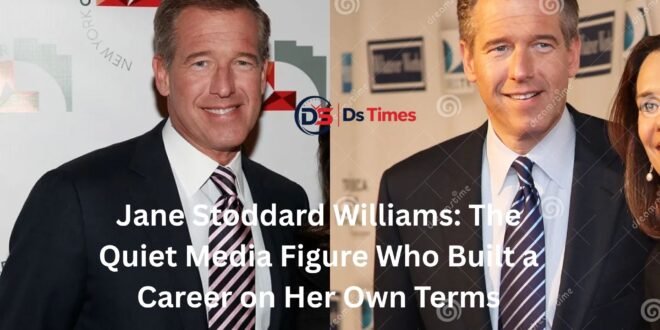
Some people become well known because they chase attention. Others end up respected because they quietly keep doing solid work for decades. Jane Stoddard Williams falls into the second group.
A lot of people recognize her name because she’s married to former NBC anchor Brian Williams. That connection is unavoidable. But if you look a little closer, her own career tells a much more interesting story. She built a long path in journalism, radio, and media management without turning herself into a celebrity personality. And honestly, that’s part of what makes her stand out.
In a media world packed with loud branding and constant self-promotion, Jane Stoddard Williams has always seemed more interested in the work itself.
A Journalism Career That Started Before the Spotlight
Jane Stoddard Williams was born into a family that already had ties to journalism. Her father, Hudson Gillan Stoddard, worked as a reporter and producer. That kind of environment tends to shape how people see storytelling from an early age.
You can picture it pretty easily: dinner conversations about current events, newspapers scattered around the house, radios always on somewhere in the background. For some kids, that sounds exhausting. For others, it becomes the foundation for a career.
She attended Duke University, where she studied political science and music. That combination actually says a lot. Political science sharpens your understanding of systems and public life. Music develops timing, rhythm, and communication in a completely different way. Oddly enough, both matter in broadcasting.
After college, she moved into journalism and media production during a period when the industry was changing fast. Radio still mattered deeply. Local newsrooms had influence. Producers and behind-the-scenes editors often shaped public conversations more than the people sitting in front of cameras.
That’s where Jane Stoddard Williams found her lane.
Why Radio Was Such a Natural Fit
Radio has always demanded a certain kind of discipline. You can’t rely on visuals to save weak storytelling. You have to understand pacing, voice, timing, and audience attention almost instinctively.
People who work in radio often describe it as intimate. Someone’s voice is literally in your car, your kitchen, or your headphones during your day. That creates a very different relationship than television.
Jane Stoddard Williams spent years working in radio production and management, including leadership roles connected to Bloomberg Radio. She eventually became an executive producer and developed a reputation for being thoughtful, organized, and sharp under pressure.
Now, let’s be honest. Executive producers rarely become household names. That’s not how media usually works. Anchors get recognized at airports. Producers solve the actual problems.
And media production is basically constant problem-solving.
A guest cancels ten minutes before airtime. Breaking news changes the lineup. Technical issues happen at the worst possible moment. A producer has to adapt quickly while keeping everything calm enough that the audience never notices the chaos behind the curtain.
That skill set doesn’t always get celebrated publicly, but inside the industry, people understand how valuable it is.
Living Adjacent to Fame Without Becoming Consumed by It
Being married to Brian Williams inevitably brought public attention into her life. During his years as anchor of NBC Nightly News, he became one of the most recognizable journalists in America.
That kind of visibility affects an entire family.
But Jane Stoddard Williams never seemed eager to build a public identity around being “the wife of” a famous anchor. She kept a relatively low profile compared to many spouses connected to high-profile media figures.
There’s something refreshing about that.
Modern public culture tends to reward overexposure. Every meal becomes content. Every opinion becomes a post. Every private moment somehow turns into branding.
Jane Stoddard Williams took almost the opposite route.
She stayed connected to serious journalism work while maintaining a level of privacy that now feels increasingly rare. You don’t see endless interviews about her personal life. You don’t see dramatic attempts to stay in headlines.
That doesn’t mean she lacked influence. It just means she operated differently.
The Family Dynamic People Often Notice
One reason people remain curious about Jane Stoddard Williams is the success of her children, especially Allison Williams, the actress known for Girls, Get Out, and several major film and television roles.
Their son, Doug Williams, also built a career in media and sports journalism.
What’s interesting is how often interviews with Allison Williams hint at a grounded family environment despite growing up around major media attention.
You hear stories about professionalism, preparation, and expectations around hard work. Not in a harsh way. More in the sense that accomplishment wasn’t treated like something automatic.
That matters.
A lot of celebrity families struggle with identity because public attention distorts normal life. Kids either reject the spotlight completely or get trapped trying to maintain an image.
The Williams family always appeared more stable than that from the outside. Of course, nobody fully knows what happens inside any family, but the public impression has generally been one of consistency rather than chaos.
And Jane Stoddard Williams seems to have played a major role in creating that balance.
The Brian Williams Controversy and Public Scrutiny
It’s impossible to discuss the family without mentioning the controversy surrounding Brian Williams in 2015, when questions emerged about inaccuracies in stories he had told publicly.
The fallout was enormous. His reputation took a major hit. NBC suspended him, and the story dominated media coverage for months.
Situations like that don’t just affect one person. Families absorb the pressure too.
One of the more notable things during that period was how little public drama came from Jane Stoddard Williams herself. There were no headline-grabbing statements. No visible effort to insert herself into the media storm.
That restraint probably wasn’t accidental.
People who spend years inside journalism understand how quickly public narratives spiral once emotions start driving coverage. Staying quiet can sometimes be the smartest move available.
And while Brian Williams eventually returned to television in a different role, the episode changed how many people viewed him permanently.
Jane Stoddard Williams, meanwhile, remained largely respected because her own professional reputation had never depended on personality-driven fame.
A Different Model of Career Success
There’s a broader reason why people continue searching for Jane Stoddard Williams today.
She represents a style of professional life that feels increasingly uncommon.
Not everyone wants to become a personal brand. Some people genuinely prefer competence over visibility. They want meaningful work, stable relationships, and long careers without constant public performance.
That approach can look almost old-fashioned now.
But honestly, there’s something appealing about it.
Think about how many public figures today seem exhausted from maintaining online personas 24/7. Every opinion becomes part of a reputation strategy. Every appearance gets analyzed instantly.
Jane Stoddard Williams came from a media era where credibility mattered more than constant exposure.
You showed up. Did the work well. Built trust slowly.
That kind of reputation doesn’t usually explode overnight, but it lasts.
Media Has Changed Since Her Early Career
The industry Jane Stoddard Williams entered looks almost nothing like today’s media environment.
When she started, audiences gathered around scheduled broadcasts. Radio stations had local identities. News anchors were treated almost like civic figures.
Now the media landscape moves at an exhausting speed. Algorithms shape visibility. Attention spans feel shorter. Outrage cycles refresh hourly.
A producer working today deals with completely different pressures than someone working in radio decades ago.
But some skills never stop mattering.
Clear communication still matters. Good judgment still matters. Knowing how to structure information for an audience still matters.
That’s probably why experienced media professionals from earlier generations continue to earn respect even as platforms evolve.
The tools change. Strong instincts don’t.
Why People Are Still Interested in Her Story
Part of the continued interest around Jane Stoddard Williams comes from simple curiosity about influential media families. That’s normal.
But there’s another layer too.
People are increasingly fascinated by individuals who managed to maintain some privacy while still participating in high-level public careers. It almost feels countercultural now.
You see this especially with younger professionals looking at older media figures. There’s often this quiet realization that fame and influence aren’t the same thing.
Jane Stoddard Williams influenced broadcasting without becoming tabloid material. She raised children who found success in competitive industries. She sustained a long marriage under intense public visibility. And she did it while largely avoiding the spectacle machine that consumes so many public figures.
That combination gets people’s attention.
Not because it’s flashy.
Because it’s rare.
The Value of Staying Grounded
One thing that stands out about Jane Stoddard Williams is the sense of steadiness attached to her public image.
Steady doesn’t sound glamorous. It won’t trend online. Nobody builds viral clips around emotional stability.
But in real life, steadiness matters a lot.
Every workplace has people who create noise and people who quietly keep things functioning. Every family has personalities that pull attention and personalities that hold structure together.
The second group often gets overlooked until things fall apart.
Media careers especially can become unstable fast. Public opinion changes quickly. Networks shift priorities. Audiences move on.
People who survive long-term usually develop resilience rather than chasing constant validation.
From everything publicly known about Jane Stoddard Williams, resilience seems much closer to her style than attention-seeking ever was.
Final Thoughts on Jane Stoddard Williams
Jane Stoddard Williams may never become the subject of endless documentaries or dramatic headlines, and that’s probably exactly the point.
Her story isn’t built around spectacle. It’s built around consistency, professionalism, and staying grounded inside an industry that often rewards the opposite.
She worked in journalism during major transitions in American media. She built a respected production career. She navigated life connected to one of television news’ most recognizable figures without losing her own identity in the process.
And maybe that’s why people continue looking her up.
Not because she demanded attention, but because she never seemed desperate for it.
In today’s media culture, that restraint almost feels radical.
