 Ds Times
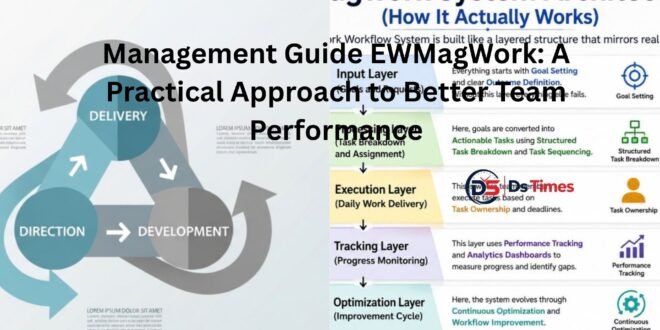
Management has never been simple. Every workplace has different personalities, goals, deadlines, and challenges competing for attention. That’s exactly why the management guide EWMagWork has gained attention among professionals looking for a more organized and realistic way to lead teams and manage work.
The idea behind management guide EWMagWork isn’t about adding more rules or creating complicated systems. It’s about making work easier to coordinate, helping teams stay focused, and improving results without creating unnecessary pressure.
Many managers struggle with the same problem. They spend most of their day responding to issues instead of leading. Emails pile up. Meetings multiply. Projects slow down. Team members become unclear about priorities. Before long, everyone feels busy, but progress becomes difficult to measure.
A structured management approach can change that.
Why Modern Management Needs a Different Mindset
Let’s be honest. The workplace looks very different today than it did a decade ago.
Teams are often spread across locations. Communication happens through multiple channels. Employees expect more flexibility. At the same time, businesses want faster results and higher productivity.
Traditional command-and-control management styles often fail in these environments because they depend heavily on supervision. When managers try to monitor everything, they quickly become overwhelmed.
The management guide EWMagWork promotes a more balanced approach. Instead of controlling every detail, managers focus on creating systems that help people perform consistently.
Think about a football coach. A good coach doesn’t run onto the field during every play. They create a strategy, train the team, communicate expectations, and make adjustments when needed. The players execute.
Workplace management follows a similar principle.
Clarity Solves More Problems Than Most Managers Realize
One of the biggest causes of workplace frustration is confusion.
Employees often know they’re supposed to complete a task, but they aren’t entirely sure what success looks like. Managers assume expectations are clear because they understand them themselves.
The gap between those two perspectives creates problems.
A marketing manager might tell a team member to “improve engagement on social media.” That sounds straightforward. But what does improvement actually mean?
Is it more comments?
More shares?
Higher click-through rates?
Better conversions?
Without clear definitions, both people may leave the conversation with completely different expectations.
The management guide EWMagWork emphasizes defining outcomes rather than simply assigning tasks. When people understand the desired result, they can make better decisions on their own.
This small shift reduces misunderstandings and saves time that would otherwise be spent correcting mistakes.
Building Accountability Without Micromanagement
Few things damage morale faster than constant oversight.
Most employees want to do good work. They don’t enjoy feeling like every decision requires approval. Yet managers often become trapped in micromanagement because they fear mistakes.
Here’s the thing: accountability and micromanagement are not the same.
Strong accountability means people understand their responsibilities and own their results. Micromanagement means controlling every step of the process.
Imagine a project manager assigning a report due Friday. Instead of asking for updates every two hours, they establish clear milestones and schedule a check-in midway through the week.
The employee has room to work independently.
The manager stays informed.
Both sides benefit.
Management guide EWMagWork encourages leaders to create accountability systems that support autonomy rather than restrict it.
Communication Is More Than Information Sharing
Many workplaces communicate constantly while still suffering from communication problems.
That sounds contradictory, but it’s surprisingly common.
Messages fly through email, chat platforms, video meetings, and project management tools. Information exists everywhere. Yet people still miss important details.
Effective communication isn’t about volume. It’s about clarity and consistency.
Good managers simplify communication whenever possible. They reduce unnecessary meetings. They summarize key decisions. They make priorities visible.
Consider a team working on a product launch. If priorities change every few days without clear explanations, confusion spreads quickly. Team members start making assumptions, and productivity drops.
When managers communicate consistently, uncertainty decreases. Teams spend less time guessing and more time executing.
The Importance of Prioritization
Every manager faces competing demands.
Customers need support.
Projects require attention.
Employees need guidance.
Leadership wants updates.
The challenge isn’t finding work to do. The challenge is deciding what matters most.
One of the practical lessons associated with management guide EWMagWork is learning how to distinguish urgent work from important work.
Urgent tasks demand immediate attention.
Important tasks drive long-term success.
Unfortunately, many organizations spend most of their energy reacting to urgent issues while neglecting important initiatives.
For example, responding to customer complaints is urgent. Improving the process that causes those complaints is important.
The first action solves today’s problem.
The second prevents tomorrow’s problem.
Strong managers learn to protect time for both.
Creating a Culture of Ownership
Ownership changes how people approach work.
Employees who feel ownership don’t simply complete assignments. They look for improvements. They identify risks early. They take pride in outcomes.
Creating that culture requires trust.
Managers often expect ownership before providing autonomy. In reality, autonomy helps create ownership.
A simple example illustrates this well.
Suppose two employees receive the same project.
The first receives detailed instructions for every step.
The second receives a clear objective and freedom to determine the best approach.
The second employee is more likely to feel personally invested in the result because they have influence over how the work gets done.
The management guide EWMagWork supports environments where people can contribute ideas, solve problems, and make decisions within defined boundaries.
That balance encourages responsibility while maintaining organizational alignment.
Handling Performance Issues Early
One of the most common management mistakes is waiting too long to address problems.
Managers often avoid difficult conversations because they want to maintain positive relationships. Unfortunately, delayed feedback usually creates larger problems.
A small performance issue can grow into a significant obstacle when ignored.
Imagine an employee consistently missing deadlines by a day or two. Initially, it seems manageable. After several months, however, project schedules become unreliable and team frustration increases.
Addressing concerns early is usually easier than fixing major problems later.
Effective managers focus on behaviors and outcomes rather than personal criticism. They discuss specific examples, clarify expectations, and collaborate on solutions.
This approach preserves respect while improving performance.
Adapting Management Styles to Different People
Not everyone responds to leadership in the same way.
Some employees thrive with broad goals and independence.
Others prefer more structure and guidance.
A management approach that works perfectly for one team member may frustrate another.
The management guide EWMagWork recognizes the importance of flexibility. Strong leaders adapt their style based on experience levels, personalities, and circumstances.
For instance, a new employee might need frequent coaching and direction during their first few months.
A seasoned professional may require little supervision and perform best with minimal interference.
The goal isn’t treating everyone identically.
The goal is helping everyone succeed.
Measuring What Actually Matters
Metrics play a valuable role in management, but only when they reflect meaningful outcomes.
Organizations sometimes become obsessed with tracking activity rather than results.
More meetings do not necessarily mean better collaboration.
More emails do not necessarily mean better communication.
More hours do not necessarily mean better productivity.
Good management focuses on indicators connected to business goals.
A sales team might track revenue growth.
A customer service department may monitor resolution times and satisfaction scores.
A project team could measure delivery deadlines and quality standards.
The management guide EWMagWork encourages managers to choose metrics that reveal progress rather than simply generate reports.
When people understand what success looks like, performance becomes easier to improve.
Sustainable Success Beats Short-Term Wins
Many teams can produce impressive results for a few weeks.
The real challenge is maintaining performance over months and years.
Burnout often occurs when organizations prioritize constant urgency. Employees work longer hours, stress levels rise, and productivity eventually declines.
Sustainable management takes a different approach.
It focuses on realistic workloads, efficient processes, and continuous improvement.
Managers who think long term understand that exhausted teams rarely produce their best work.
Consistency often outperforms intensity.
A team that delivers steady, reliable results year-round usually creates more value than one that alternates between frantic effort and recovery periods.
That perspective sits at the heart of effective leadership.
Final Thoughts
The management guide EWMagWork offers a practical framework for navigating the realities of modern leadership. Its value comes from focusing on fundamentals that consistently matter: clear communication, accountability, prioritization, ownership, adaptability, and sustainable performance.
Great management isn’t about controlling every detail or having all the answers. It’s about creating an environment where people can do their best work while moving toward shared goals.
When managers provide clarity, build trust, and focus attention on what truly matters, teams become more productive, more engaged, and far more capable of handling challenges. That’s not a management trend. It’s a principle that continues to work regardless of industry, team size, or workplace changes.
