 Ds Times
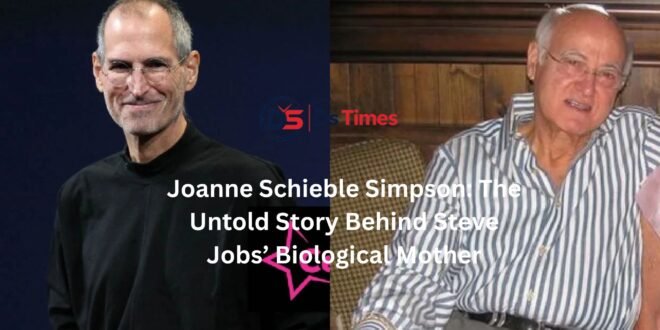
Some lives shape history from the spotlight. Others do it quietly, from the edges. Joanne Schieble Simpson belongs firmly in the second group.
You probably know the story of Steve Jobs — the adopted kid who co-founded Apple Inc., got fired, came back, and changed how we use technology. It’s been told a thousand times. But the woman who made one of the hardest decisions of his life possible? She’s often reduced to a footnote.
Her story deserves more space than that.
A young woman with a difficult choice
Picture this: it’s the mid-1950s in the United States. Being an unmarried pregnant college student isn’t just frowned upon — it can derail your entire future.
Joanne Schieble was exactly that.
She was studying, ambitious, and in a relationship with Abdulfattah Jandali, a Syrian graduate student. Their relationship wasn’t accepted by her family. That mattered more back then than most people today realize.
Here’s the thing — when your family controls your financial support, your housing, your future… their opinion isn’t just “input.” It’s leverage.
So when she became pregnant, she was cornered.
Not because she didn’t care. Quite the opposite.
The adoption that changed everything
Joanne didn’t just give her child up for adoption randomly. She had conditions.
That part often gets overlooked.
She wanted her baby to be adopted by college-educated parents. That mattered deeply to her. Education was her anchor — and she wanted the same for her child.
At first, the planned adoptive parents backed out. That left things uncertain. Eventually, Paul Jobs and Clara Jobs stepped in.
They weren’t college graduates.
That could’ve been the end of it.
But they made a promise — they would ensure the child went to college. That was enough for Joanne. She agreed.
Now imagine signing those papers. Not knowing what life your child will have. Not knowing if you’ll ever see them again.
It’s easy to talk about adoption in abstract terms. It’s much harder to sit with what that moment actually feels like.
Not absence, but distance
There’s a quiet misconception that Joanne simply “disappeared” from the story after the adoption.
That’s not entirely true.
She went on to build her own life. She later married Abdulfattah Jandali, and they had another child together — Mona Simpson, who would grow up to become a respected novelist.
Here’s where things get interesting.
Mona Simpson eventually formed a close relationship with Steve Jobs as adults. Through her, a bridge formed between the separated parts of the family.
But Joanne’s connection with Steve was more complicated.
Not dramatic. Not explosive. Just… distant.
And that kind of distance can be harder to define.
Why her story often gets simplified
Let’s be honest. People like clean narratives.
Adopted genius. Garage startup. Billion-dollar company. Redemption arc.
That version of the story doesn’t have much room for moral gray areas or quiet sacrifices.
Joanne’s decision doesn’t fit neatly into a feel-good storyline. It raises uncomfortable questions:
What would you do in her position?
Would you make the same choice?
Could you live with it?
That’s probably why her story often gets compressed into a single sentence.
But when you slow it down, it’s anything but simple.
The ripple effect of one decision
It’s tempting to treat big historical outcomes as inevitable. Like Steve Jobs was always going to become Steve Jobs.
But life doesn’t work like that.
Change one variable — just one — and everything shifts.
If Joanne had kept her son, his upbringing would’ve been completely different. Different environment. Different influences. Different opportunities.
Maybe he still becomes brilliant. Maybe not.
Maybe Apple Inc. still exists. Maybe it doesn’t.
That’s the strange thing about pivotal decisions. You don’t see their full impact in the moment.
You just make the best call you can with what you have.
A more human way to see her
It’s easy to judge decisions made decades ago using modern standards.
But context matters.
Back then, Joanne wasn’t choosing between two equally supported paths. She was choosing between losing her family’s support or giving her child a chance at a stable life.
That’s not a clean choice. It’s a constrained one.
And when you look at it that way, her decision starts to feel less like abandonment and more like strategy.
A painful one. But intentional.
The quiet influence she still had
Even without being present in Steve Jobs’ early life, Joanne’s influence didn’t vanish.
Think about it:
She insisted on education.
She made sure her child went to a family that valued opportunity.
She set conditions, even when she had limited power.
Those early boundaries shaped the path that followed.
And later in life, Jobs did learn more about his biological background. That knowledge mattered to him, even if the relationships weren’t perfectly smooth.
People don’t need constant presence to leave a mark. Sometimes a single decision echoes for decades.
The complexity of reunion
Reunions between biological parents and children aren’t movie scenes most of the time.
They’re layered.
There’s curiosity, yes. But also awkwardness. Expectations. Sometimes disappointment. Sometimes relief.
Joanne and Steve did reconnect, but it wasn’t a headline-making relationship.
And that’s okay.
Not every story resolves into a neat emotional payoff.
Sometimes, closure looks like understanding rather than closeness.
Why her story still matters today
You might wonder why Joanne Schieble Simpson’s story still resonates.
Here’s why:
It speaks to choices made under pressure.
It reminds us that people are shaped by circumstances as much as intentions.
And it shows that behind every well-known figure, there are lesser-known lives that played critical roles.
Today, conversations around adoption, identity, and family are more open. But the emotional core hasn’t changed much.
People still face impossible decisions.
They still try to do what’s best with incomplete information.
They still carry the weight of those choices.
A small, real-life parallel
Think about someone choosing between two imperfect job offers.
One pays well but limits growth. The other offers opportunity but comes with risk.
Now multiply that tension by ten. Add social pressure, family expectations, and long-term consequences.
That’s closer to what Joanne faced.
Except her decision wasn’t about a job. It was about a life.
The part people don’t say out loud
Let’s be honest for a moment.
It’s easier to celebrate outcomes than to sit with the cost behind them.
We admire success stories like Steve Jobs’. But we don’t always pause to consider the emotional trade-offs that made those stories possible.
Joanne’s story is one of those trade-offs.
It doesn’t need to be romanticized. It doesn’t need to be criticized harshly either.
It just needs to be seen clearly.
Closing thoughts
Joanne Schieble Simpson didn’t build a tech company. She didn’t give keynote speeches or design iconic products.
But she made a decision that shaped one of the most influential lives of the modern era.
Not from a position of power — but from a place of constraint.
And that’s what makes her story worth remembering.
Because history isn’t just driven by bold public moves. Sometimes, it’s shaped by quiet, deeply personal choices that never make headlines.
